
Making Cape Ann a Little More Awesome: The Stories Behind Rockport and Gloucester’s Murals
From $1,000 grants to larger-than-life murals, Awesome Rockport and Awesome Gloucester are proving that a little creativity, a generous community, and a few buckets of paint can go a remarkably long way.
There’s something rather satisfying about discovering a piece of art where you least expect it.
Maybe it’s a giant mackerel keeping a watchful eye over Gloucester’s working waterfront. Or a beautiful sunset stretching across a wall tucked behind the Rockport Public Library. Perhaps it’s a familiar painting by Winslow Homer or Fitz Henry Lane, recreated on the side of a building where thousands of people can appreciate it without ever setting foot inside a museum.
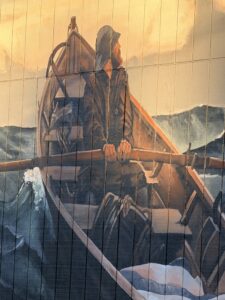
These aren’t random acts of artistic expression. They’re part of a growing collection of public murals commissioned by Awesome Gloucester and Awesome Rockport, two community organizations that have spent more than a decade finding creative ways to make Cape Ann, well, a little more awesome.
And behind those murals are three individuals worth getting to know: Awesome Foundation chapter founder Sal Zerilli and artists Josh Falk and Dana Woulfe.
Cape Ann Magazine first shared the story of Awesome Gloucester and Awesome Rockport a few months back, beating us to the punch (Well played, Cape Ann Magazine…well played. 😉). But a little friendly competition has never dampened our curiosity. We were still eager to dig a little deeper, meet the people behind the murals, and hopefully paint a few new details into the picture. Pun absolutely intended.
The Awesome Foundation: Small Grants, Big Ideas
The story actually begins in Boston in 2009, with the creation of the Awesome Foundation, an unconventional philanthropic movement built around a wonderfully simple idea: gather a group of people willing to contribute their own money and give it away to people with creative ideas. No elaborate grant applications. No complicated reporting requirements. And, perhaps most surprisingly, no strings attached. The foundation eventually expanded into a worldwide network of independently operated chapters, each working to support projects that make its own community a better, more interesting place.
Sal Zerilli first encountered the concept while living in Toronto and saw an opportunity to bring that same spirit to Cape Ann. He established Awesome Gloucester in 2013, followed by Awesome Rockport in 2015. Today, the two chapters have collectively awarded approximately $300,000 to community projects, including 245 grants in Gloucester and 55 in Rockport, according to Zerilli at the time of our interview. That’s a remarkable amount of community investment, particularly considering where most of the money comes from.
While the murals tend to attract the headlines, Zerilli was particularly eager to recognize the trustees who make the organization’s work possible. These are ordinary Cape Ann residents who contribute their own money, volunteer their time, review applications, and help decide which community projects deserve support. Most of the funding still comes directly from trustees pulling cash out of their own pockets, without any expectation of recognition.
“I would love for their flowers to be watered in this article,” Zerilli told us. “They’re really amazing people… this is all really being fueled by your neighbors, people living a quarter mile from you.”
And we think those flowers deserve a little watering.
So how does someone get an Awesome grant?
In Rockport, the chapter conducts five grant cycles each year, typically receiving between 10 and 20 proposals per cycle. Trustees review the applications, deliberate, and select three finalists, who are invited to participate in what the organization calls Pitch Night. Each finalist gets five minutes to make their case, followed by questions from the trustees. The trustees then retreat to deliberate before returning to announce the winner.
And the prize? One thousand dollars. In cash. Presented in a sandwich bag. No, seriously. It’s a refreshingly informal approach to philanthropy, and one that reflects the foundation’s philosophy of trusting people to do something worthwhile with a little financial encouragement.
Gloucester follows a similar model, awarding grants monthly.
The projects themselves vary enormously. In Rockport, Awesome funding has helped support the town’s Fourth of July parade and bonfire, replacement lanterns for Illumination Night, restoration work at the Old Fifth Parish Burying Ground, improvements at the Pigeon Cove Circle, and planting initiatives including Project Elm and a particularly photogenic dahlia field. More recently, grants have supported Christmas in Rockport and Cape Ann Arts Alive’s choral arts programming.
Some projects bring hundreds of people together. Others improve a small corner of town or preserve something that might otherwise be forgotten. And that’s part of the appeal. A project doesn’t have to be enormous to be awesome.
Interestingly, the foundation doesn’t require recipients to submit follow-up reports proving that their projects succeeded. Zerilli explained that the organization operates on trust, recognizing that not every worthwhile idea will unfold exactly as planned.
It’s an approach that might seem unusual in an era of metrics, paperwork, and accountability reports, but it also makes the funding accessible to people who might never pursue a more traditional grant.
From One Empty Wall to a Maritime Mural Series
The murals began with a dog walk.
Sal Zerilli used to walk the same path behind the Rockport Public Library every day, passing a long, empty wall that seemed to be crying out for something more interesting.
“When you travel to Europe, or other big cities, you see public art everywhere,” he recalled. “Why wouldn’t we put something beautiful on this wall? It’s right behind the library — the library has this amazing set of benches, it’s a beautiful area.”
The wall belonged to Rockport Music, which agreed to the project. But Awesome Rockport didn’t yet have an artist in mind. So, in a departure from its usual approach, the organization put out an open call to the local art community. It was the first, and so far only, time the chapter has selected a muralist that way. The artist chosen was Josh Falk, a Rockport resident whose background in graffiti and large-scale painting made him particularly well suited to the challenge.
The finished work, completed in 2019, became the Sunset Mural, a 72-foot panorama assembled from two of Falk’s own photographs. One captured the view from Back Beach as a storm passed offshore. The other was taken at Loblolly Cove. Falk deliberately chose scenes that reflected a different side of Rockport from its most recognizable landmark.
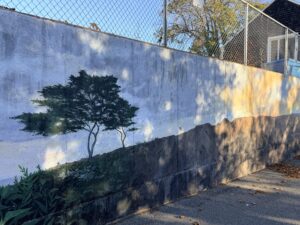
“I’d want to do a mural that isn’t so Motif Number One-centered,” he explained. “People come for that, but there’s people who spend more time in the rocks, fishing, in the outdoors, than looking at the motif.”
For Falk, the project also became a meaningful introduction to the community. He had moved to Rockport and was living on Bearskin Neck, gradually getting to know neighbors, fishermen, and local business owners. But painting the mural offered a different opportunity to connect. As he worked, people stopped to ask questions, offer encouragement, and share their appreciation for what was taking shape.
The project stretched from September into October as Falk balanced the painting with other commitments, sometimes returning after work to add another section or refine a detail. By the time it was finished, he had created more than a beautiful piece of public art. He had also developed a deeper sense of belonging in the town he now called home.
And the mural sparked an idea.
Why stop at one?
Zerilli explained that the organization hadn’t originally set out to create a series. But as discussions about additional murals developed, the trustees agreed on one guiding principle: the artwork should reflect Cape Ann’s maritime identity. That might mean celebrating the fishing industry, recreating a historic painting, or capturing some familiar element of life along the coast.
The idea eventually evolved into what the organizations now call their Maritime Heritage Mural Series.
By the time of our interviews, the series had grown to 11 murals across Gloucester and Rockport. Some celebrate working people. Others pay tribute to celebrated artists who helped establish Cape Ann’s reputation as an important American art destination. Still others simply capture the beauty, character, and occasional eccentricity of life beside the ocean. The current listing of 11 murals and their locations may be found at the end of the article.
How Do You Choose a Wall, Anyway?
Commissioning a mural involves considerably more than finding a blank wall and handing an artist a paintbrush. According to Zerilli, the process typically begins with the Awesome team identifying a visible location, developing a concept, and approaching the property owner for permission and access. Awesome handles the cost through a separate fundraising effort, sometimes supported by grants and partners, with the Gloucester Fund serving as fiscal sponsor. From there, trustees and artists work through the design, budget, and logistics.
But as the murals have gained recognition around Cape Ann, something interesting has happened: property owners have started approaching Awesome.
Take the Holy Mackerel Mural on the Americold Logistics building along Rogers Street in Gloucester. After seeing another Awesome mural nearby, a neighboring property owner helped connect the organization with Americold, which had a massive wall it hoped to fill. The Awesome team suggested a more publicly visible location and proposed an enormous mackerel celebrating Gloucester’s fishing heritage.
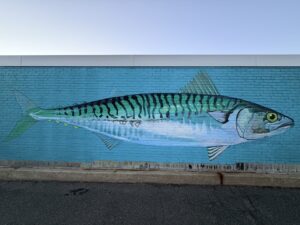
In a fortunate coincidence, the design also complemented Americold’s corporate branding.
“The color of the fish and the background is actually part of Americold’s brand color palette,” Zerilli explained. “They were like, that’s amazing.”
That coincidence helped as the project navigated multiple levels of corporate approval. Eventually, Gloucester gained a striking 24-foot fish overlooking the waterfront, a fitting example of how a mural program that began behind the Rockport library has grown into something local businesses now actively seek out.
Meet the Artists: From Graffiti to Gloucester
If you’ve admired the murals around Cape Ann, you’ve likely admired the work of Josh Falk and Dana Woulfe, two artists whose friendship and creative partnership began long before either was painting historic ships, fishermen, or giant mackerel. And their artistic backgrounds might surprise you.
Both emerged from Boston’s graffiti and street-art community, eventually becoming involved with Project SF (Studio Fresh), an artist collective exploring ways to push graffiti beyond its traditional boundaries.
Falk grew up in Leominster, surrounded by builders, craftspeople, and artists. Woulfe grew up in Rhode Island, influenced by his grandmother, a professional illustrator and painter, before studying illustration at Massachusetts College of Art.
Their paths crossed in Boston, where Woulfe already knew Falk by reputation in the graffiti scene. Through Project SF, they began collaborating and experimenting with different styles, eventually building Studio Fresh, a business specializing in large-scale murals, graphics, and creative projects for commercial clients and public spaces.
Today, they operate independently but still collaborate on Awesome projects, with a natural division of labor developed over years of working together.
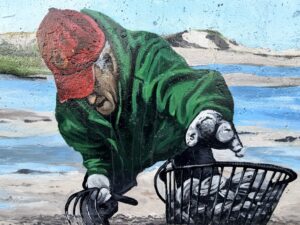
“We don’t really have to talk about it,” Woulfe said of painting side by side. “We kind of naturally find our own spaces… he gravitates to the water stuff, I gravitate to the sky.”
While they share an artistic history, their connections to Cape Ann are different. Falk, now a Rockport resident, is an avid fisherman and outdoorsman whose time exploring the rocky coastline and observing its changing conditions influences his artwork. His murals reflect places he knows firsthand rather than generic coastal scenes.
For Woulfe, who lives in Essex, recreating historic maritime paintings represents a departure from his earlier work in graffiti, abstraction, and contemporary design. But he’s found unexpected satisfaction in creating art that his neighbors, friends, and even his children’s friends’ parents encounter in their everyday lives.
The Awesome murals offer both artists a chance to challenge themselves creatively while giving something back to their communities. Two artists who began in graffiti, an art form often associated with unauthorized urban walls, are now being invited by businesses and communities to transform those same spaces into celebrated public art.
Not a bad evolution for a couple of guys who started out with spray cans.
From Computer Screen to Concrete: How a Mural Comes to Life
One of the more fascinating parts of our conversations with Falk and Woulfe was learning how these enormous paintings actually get onto a wall. After all, recreating a famous Winslow Homer painting is challenging enough on a canvas. Doing it on the side of a building, while standing on a lift and dealing with unpredictable New England weather, introduces a few additional complications.
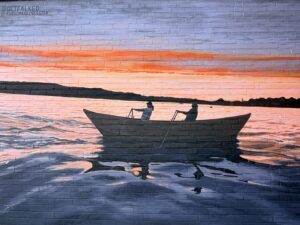
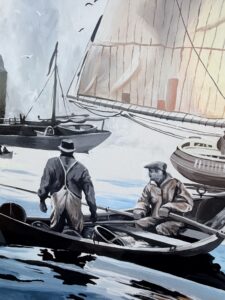
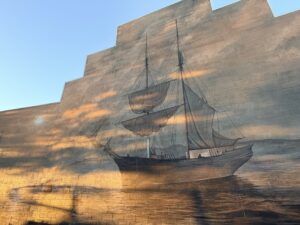
The process begins long before the first brushstroke. The artists need to understand the dimensions and condition of the surface, develop or adapt a design, estimate materials and labor, and determine how the artwork will translate to its new scale. And unlike a traditional canvas, buildings rarely offer perfectly convenient proportions. The Fitz Henry Lane mural on Gloucester’s Harbor Loop, for example, presented a particular challenge because the wall’s shape didn’t match the proportions of the original painting. The artists had to adapt the composition while preserving the recognizable qualities of Lane’s work.
Woulfe recalled that the mural was among their most challenging, particularly because of its awkward layout and a sky that took several attempts to get right.
So how do they transfer the image? One of their preferred techniques involves using a computer and projector. After preparing the digital design, they wait until it’s dark enough to project the image onto the wall. They then trace important elements of the composition, establishing the basic structure that will guide the painting. For a historic maritime scene, that might mean identifying the horizon, the shape of a boat, and the movement of the waves.
Once those reference points are in place, the artists work largely by hand, referring to printed images as they build up the painting.
And as Woulfe pointed out, mistakes aren’t necessarily catastrophic.
“Paint always fixes paint,” he explained.
In other words, if something doesn’t look right, you paint over it and try again.
A reassuring philosophy, although probably easier to embrace when you have their level of talent.
The Haystack Mural: An Aquarium at Old Garden Beach
The latest addition to the Awesome mural collection brings us back to Rockport, specifically to Old Garden Beach. If you’ve spent time there, you’re probably familiar with the small utility structure overlooking the water. Not exactly the first place you’d expect to find a work of art. But thanks to a collaboration between Awesome Rockport and the Old Garden Beach neighborhood community, the structure has been transformed into an imaginative underwater scene.
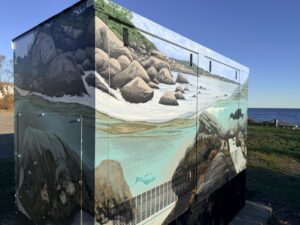
The project was initially referred to as the Fish Tank Mural, a name Falk particularly liked because it reflected the original concept: turning the utility box into something resembling an aquarium. Local residents favored another name, the Haystack Mural, in recognition of a familiar offshore rock. Haystack is part of a collection of rocks that generations of local swimmers have known by names including Giant, Baby Giant, and Bathtub.
The mural’s design brings that familiar seascape to life both above and below the waterline. A cormorant spreads its wings above the water, while striped bass swim below and a lobster shelters among the seaweed. It’s an appealing concept because it takes something that most people would normally walk past without a second glance and turns it into a celebration of the natural world just offshore.
And it presented an interesting artistic challenge. Unlike a flat wall, the utility structure required Falk to develop a continuous image that would make sense from multiple directions.
“You’re creating this panoramic image on a three-dimensional surface that has to connect,” he explained. “If you’re standing on this side, this is what you’d see, and if you’re standing this way, this is what you’d see.”
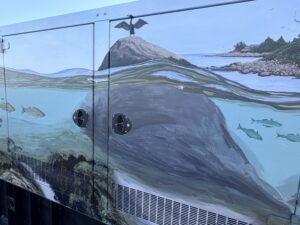
Falk estimated spending eight to ten hours developing the design over several sessions before beginning the actual painting. The physical work took seven days, a little longer than the week he’d originally planned. The culprit? Cape Ann weather, naturally. A stretch of particularly windy conditions sent salt spray across the utility structure, requiring Falk to hose it down each morning before he could resume painting.
And painting in such a public setting invited can solicit artistic advice, sometimes which is actually integrated into the final piece. While working on the Old Garden Beach mural, he reconsidered the appearance of Haystack Rock after a discussion about how much seaweed typically covers it. He went back and adjusted the painting to better reflect the real thing.
It’s a small detail, but an interesting illustration of how the community can influence public artwork even after painting has begun.
And it says something about the people who live here.
We tend to know our rocks.
Art That Has to Survive New England
Creating a mural is one challenge. Keeping it looking good through years of sun, salt air, rain, snow, and whatever else a Cape Ann winter throws at it is another.
Falk explained that longevity begins with proper surface preparation. Concrete, metal, and wood each require different treatments and primers, followed by high-quality exterior paints and protective coatings that help resist fading and weather damage.
A well-executed outdoor mural can last around ten years, although exposure and materials make a difference. Falk considers the recreation of Winslow Homer’s The Fog Warning at the Gloucester Rental Center particularly vulnerable because it’s painted on wooden siding, where moisture can eventually compromise the artwork.
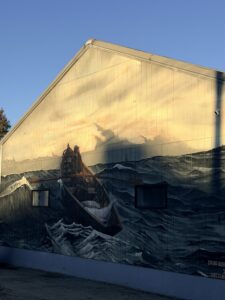
Fortunately, he hasn’t observed significant deterioration among the local murals discussed. But longevity raises another question, particularly for murals on town-owned property: Who will maintain them, fund repairs, and ensure they’re preserved years from now?
Falk takes a practical view. If a mural reaches the end of its useful life after a decade, perhaps the answer is simply to paint something new.
What’s Next for Cape Ann’s Murals?
With 11 murals completed or commissioned, it’s natural to wonder just how many more walls might eventually become part of the collection.
Falk, for one, already has a potential future project in mind. His dream Rockport wall is a curved, somewhat overlooked utility structure near Barletta Park in downtown Rockport, across from the area where the farmers market is held. He loves the unusual shape of the structure and the creative possibilities it presents. There have been discussions about the location, although the question of future maintenance remains a consideration.
Woulfe has a somewhat different wish. He’d love to bring a mural to his own town of Essex, celebrating the river and shipbuilding history that helped shape the community. There’s just one rather significant obstacle: Essex has very little public wall space available.
“It’d be really cool to have something where I live,” he told us.
Whether any of these projects eventually happens remains to be seen. But if the last several years have demonstrated anything, it’s that an unremarkable wall can become something extraordinary when the right people see its potential.
More Than Just Paint on a Wall
Whether supporting local traditions, preserving history, or transforming ordinary walls into works of art, the Awesome Foundation’s efforts begin with one simple question: What could make this community a little better?
For Zerilli and the trustees, it’s about giving back, often without recognition; for artists Josh Falk and Dana Woulfe, it’s about celebrating the places they call home.
And for the rest of us, it’s an invitation to look a little closer and appreciate the creativity, history, and community spirit behind these works.
Because behind every mural is a story worth telling. And perhaps that’s the most awesome part of all.
Mural Chasing – Locations of all current (11) Awesome murals.
- The Sunset Mural — 17 School St., Rockport (behind Rockport Public Library) — Josh Falk
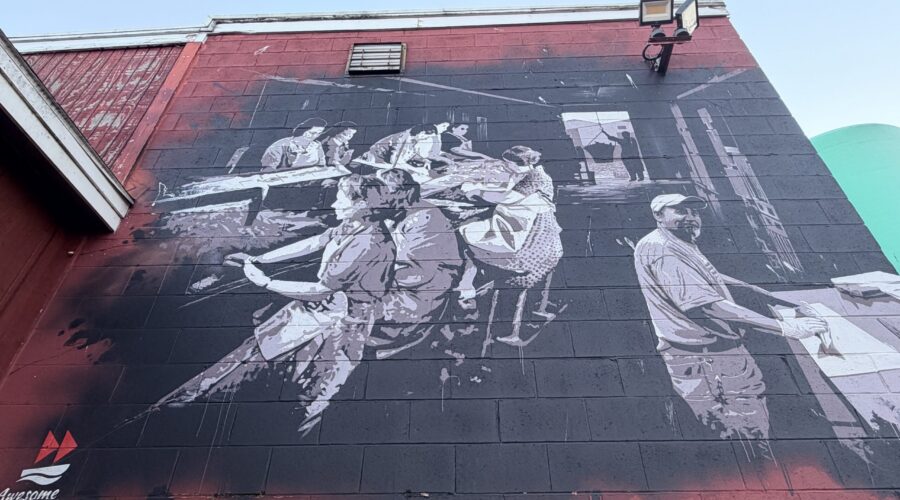
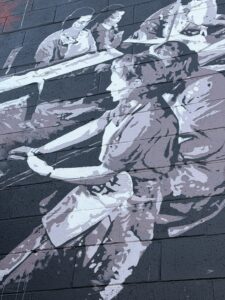
- The Fish Workers Mural — 88 Commercial St., Gloucester — Josh Falk & Dana Woulfe
- The Workers Mural — 24 Harbor Loop, Gloucester — Josh Falk & Dana Woulfe
- The Doryman’s Mural — 23 Harbor Loop, Gloucester — Josh Falk & Dana Woulfe
- The Winslow Homer Mural — 159 Maplewood Ave., Gloucester — Josh Falk & Dana Woulfe
- The Sacred Cod Mural — 2 Fort Square, Gloucester — Josh Falk
- The Fitz Henry Lane Mural — 11 Harbor Loop, Gloucester — Josh Falk & Dana Woulfe
- The Dory at Sunset Mural — 3 Porter St., Gloucester — Josh Falk
- The Holy Mackerel Mural — 1 Row Square, Gloucester — Josh Falk
- The Homer Fog Warning Mural — 32 Maplewood Ave., Gloucester — Josh Falk & Dana Woulfe
- Haystack Mural — Old Garden Beach, Rockport (generator box) — Josh Falk