
A Sweet Tradition: Nearly 100 Years of Candy Making at Rockport’s Tuck’s Candy
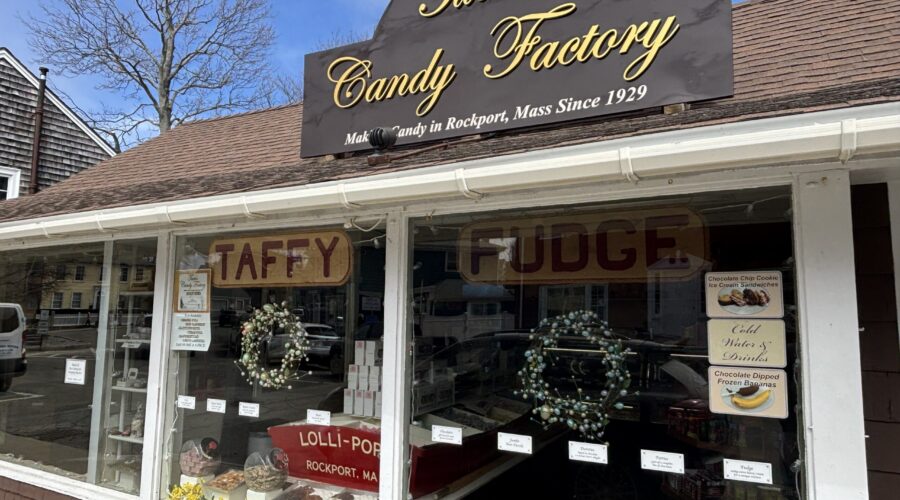
From a candy counter beneath a dentist’s office to handmade candy canes and generations of family traditions, Tuck’s Candy has been satisfying Rockport’s sweet tooth since 1929.
There are certain businesses that become so intertwined with a town’s identity that it’s difficult to imagine one without the other. In Rockport, Tuck’s Candy is one of those places.
For nearly a century, the Tuck family has been turning sugar, chocolate, and a little bit of chemistry into some of the town’s sweetest traditions. Generations of visitors have wandered through its doors in search of saltwater taffy, chocolates, and old-fashioned candy canes, often returning years later with children and grandchildren of their own.
But behind the colorful displays and irresistible aromas is a family story that stretches back to 1929, when a young man named Walter Tuck decided to make a career out of candy.
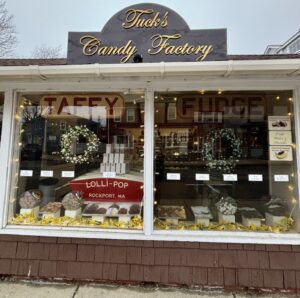
And, as it turns out, the original business arrangement was particularly well suited to keeping the family dentist busy.
From Lobsters to Lollipops
Walter Tuck didn’t originally set out to become a candy maker. After graduating from high school in 1922, he pursued a career as a chef. According to his grandson Dan Tuck, who now operates the Dock Square candy shop and manufacturing business, Walter spent one summer cracking lobsters for restaurant dishes until the constant exposure to raw lobster made him sick.
Apparently, a lifetime of handling sugar sounded considerably more appealing.
Walter eventually apprenticed with several candy companies, learning the techniques and recipes that would form the foundation of his own business.
In 1929, he opened a candy-making operation at 15 Main Street in Rockport, working alongside his twin brother, who was a pharmacist. The original establishment was considerably more than a candy store, featuring a full pharmacy, soda fountain, ice cream counter, and candy shop, with the manufacturing taking place in the basement.
And upstairs? Walter’s father, Dr. Albert Tuck, maintained his dental practice.
Yes, a candy store downstairs and a dentist upstairs. One might argue the Tuck family had discovered the perfect business model.
The arrangement provided a convenient combination of sweets and dental care, although there’s no historical evidence that Dr. Tuck offered a family discount for cavities acquired downstairs.
As the business grew, the candy-making operation relocated to Squam Hill in 1947, where the family converted a large room in the Tuck family home into a candy factory.
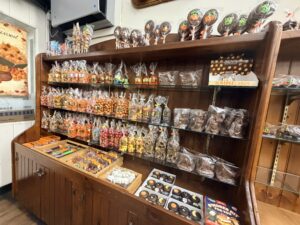
It was a considerable space, Dan recalls, perhaps three or four times the size of today’s manufacturing area. And with multiple generations of the family living upstairs, the commute to work was about as convenient as it gets.
In the mid-1990s, manufacturing moved to its present location in Dock Square, bringing the candy-making process directly into the heart of Rockport’s bustling visitor district.
That move would prove especially important to the business’s holiday traditions.
The Recipe for Nearly a Century of Success
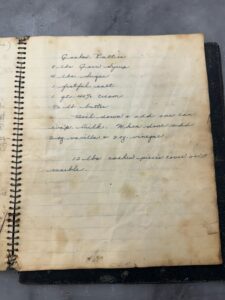
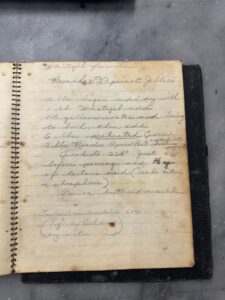
Some family businesses pass down jewelry, furniture, or treasured photographs. The Tuck family has something arguably more delicious: a handwritten recipe book containing Walter’s original candy recipes.
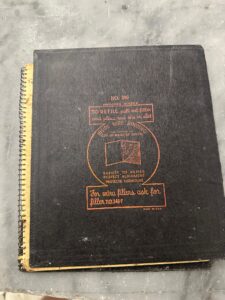
The worn brown book, remains somewhere among the family’s historical belongings, according to Dan.
And while ingredients and customer tastes have evolved over the decades, many of Walter’s original recipes and techniques are still used today.
“We still do use the same techniques that he used,” Dan explains.
The family takes particular pride in its candy canes, which are still made much as Walter would have made them nearly a century ago.
Traditional candy making is as much science as it is art. Creating a candy cane involves heating sugar and other ingredients to approximately 300 degrees, allowing excess moisture to evaporate. The hot mixture is then transferred to a metal table to cool before being stretched and pulled to develop the desired texture and appearance.
It’s a process that requires careful attention to temperature, timing, and technique, particularly when working with sugar that can change consistency remarkably quickly.
But Dan is refreshingly candid about the idea of secret family recipes.
Among small, independent candy makers, he says, there’s actually considerable cooperation and knowledge sharing. Many recipes overlap, and confectioners often exchange advice about ingredients, techniques, and production challenges.
The magic isn’t necessarily in possessing some closely guarded formula. It’s in knowing how to make the candy properly, consistently, and by hand.
“We keep tradition, but you got to keep up with the current trends too,” Dan says.
And that’s precisely what Tuck’s has managed to do.
The Sweet Smell of Nostalgia
Ask Dan which candy has stood the test of time, and one product rises to the top: saltwater taffy.
“Saltwater taffy overall has probably been the leader throughout for as long as I can remember,” he says.
But what customers buy today isn’t necessarily what they would have purchased in Walter’s day.
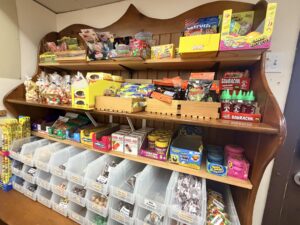
Before modern air conditioning, the summer heat placed considerable limitations on what candy makers could produce and display. Chocolate, for example, was far less practical during the warmest months, so hard candies and other heat-tolerant confections played a larger role in the business.
Today, temperature-controlled shops allow for a much broader assortment of chocolates and other treats throughout the summer.
Customer preferences have changed, too. Some once-popular candies have gradually disappeared from everyday demand, while others survive largely because of the memories they evoke.
Take ribbon candy, for example.
Dan frequently encounters customers who remember seeing it in their grandparents’ candy dishes. They purchase it not necessarily because it’s their favorite candy, but because it reminds them of childhood.
“Well, my grandma used to have this in her candy dish all the time,” Dan recalls customers telling him.
And sometimes, that memory is sweeter than the candy itself.
Of course, nostalgia doesn’t mean the business is stuck in the past.
Tuck’s has experimented with more contemporary creations, including chocolate-covered Devil Dogs, chocolate-covered Twinkies, and sea salt caramels.
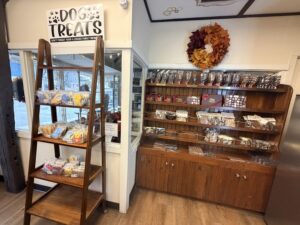
Dan was initially skeptical about the sea salt caramels.
“You put sea salt on them. I’m like, no, there’s no way they’re going to sell.”
Today, they’re the shop’s number-one-selling caramel.
A useful reminder that even after nearly 100 years, there’s still room for a few surprises.
As for Dan’s personal preferences, after a lifetime spent around candy, he still enjoys the occasional sample in the name of quality control. His favorite is almond butter crunch.
His least favorite? Butter rum taffy.
Apparently, some childhood memories are better left unwrapped.
When Candy Making Becomes a Family Tradition
Although summer remains Tuck’s busiest season, Christmas holds a particularly special place in the business’s history.
Each fall, production begins on the shop’s traditional handmade candy canes, with preparations starting well before the holiday rush.
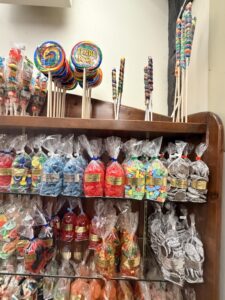
An earlier newspaper account described the business producing more than 5,000 candy canes annually, an impressive undertaking considering the hands-on process involved.
According to Dan, moving the manufacturing operation to Dock Square in the 1990s dramatically changed the Christmas business.
“Especially the Christmas business, it took off in leaps and bounds,” he recalls.
The demonstrations turned what might otherwise have been a seasonal shopping trip into an annual family experience.
“I’ve seen parents come in, now they’re bringing their kids, now they’re bringing grandkids,” Dan says. “It’s kind of become tradition for them to come down here.”
The seasonal calendar continues well beyond Christmas. Easter preparations begin in late January, with chocolate molds and other seasonal treats ready to take their place as soon as Valentine’s Day passes.
Interestingly, Dan says Valentine’s Day has never been a particularly significant holiday for Tuck’s, even dating back to his father’s years running the business.
We’ll leave it to Rockport’s romantics to decide whether that’s a missed opportunity.
A Changing Rockport, an Enduring Business
Few businesses have witnessed Rockport’s evolution quite like Tuck’s.
From its beginnings in the late 1920s through the postwar tourism boom and into the modern era, the candy shop has experienced decades of changing visitor habits.
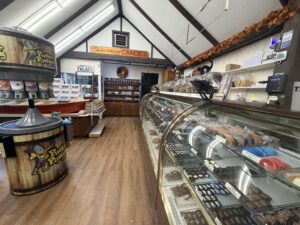
Today, Dan believes the nature of tourism has changed. Visitors have more destinations and activities competing for their attention, and the traditional weeklong coastal vacation has increasingly given way to shorter stays and day trips.
He suspects Rockport may have attracted larger crowds in decades past, although he acknowledges that actual visitor statistics might tell a different story.
And he’s quick to emphasize that business remains strong.
“The weather’s nice, it’s fantastic,” he says. “Business is still great, but it’s just different.”
For a business approaching its hundredth anniversary, adapting to those changes is essential.
The cost of ingredients continues to rise, staffing presents challenges, and customer expectations evolve. Tuck’s has also embraced online sales and a growing mail-order business, allowing customers to enjoy its handmade confections even when they’re far from Rockport.
But Dan has no interest in abandoning the traditions that made the business successful.
“I love what I do,” he says. “It’s close to a hundred years. That’s huge, especially now you don’t see many businesses in general have that kind of longevity.”
And after decades of working around candy, he can’t imagine doing anything else.
The Next Hundred Years?
In 2029, Tuck’s Candy will celebrate its 100th anniversary, a remarkable milestone for any family-owned business, particularly one that continues to manufacture its products using techniques passed down through generations.
Dan hasn’t finalized plans for the celebration, but he’s already considering a few possibilities.
One idea is to research the original prices of Walter’s candies and offer selected products at their 1929 prices for a limited time. Another is to participate in Rockport’s Fourth of July parade as part of the anniversary festivities.
He’s also hoping to learn more about the business’s earliest days from his father, including the exact opening date.
And while the anniversary will undoubtedly be an opportunity to celebrate the past, Dan is also thinking about the future.
His youngest son, 14-year-old Christopher, has already expressed an interest in someday taking over the family business.
“My youngest is 14. He keeps telling me he’s going to take over,” Dan says. “So we’ll see if that happens.”
Should Christopher eventually follow through, it would extend the Tuck family candy-making tradition into a fourth generation.
For now, the business continues much as it has for nearly a century: sugar heating, chocolate cooling, candy being pulled and shaped, and customers returning for the treats they remember from years gone by.
Rockport has changed considerably since Walter Tuck first opened his candy operation beneath his father’s dental practice in 1929.
But some things remain wonderfully familiar.
And perhaps that’s the real secret to Tuck’s success.
It’s not simply the recipes, the handmade chocolates, or even the candy canes.
It’s the ability to make something that tastes just as sweet as you remember.