

Josh Ritter on Rockport, Painting, Storytelling, Boston and the “Same Juice” Behind It All
For Josh Ritter, songwriting has never been simply about writing songs.
Over a career spanning more than two decades, the Idaho-born singer-songwriter has built a reputation for narrative-driven Americana, releasing acclaimed albums including The Animal Years, The Historical Conquests of Josh Ritter, Gathering and, most recently, I Believe in You, My Honeydew. He has also written two novels, developed a passion for painting and recently launched a Substack, The Book of Jubilations, as another way to connect directly with his audience.
In other words, Ritter has accumulated quite a few ways to tell a story.
He’ll bring one of them—music—to Rockport’s Shalin Liu Performance Center on October 28, and fortunately for Rockport MA Guide, he was willing to talk about several of the others.
We caught up with Ritter ahead of his visit to discuss how he plans to spend his day in Rockport, why painting has changed the way he sees the world, the unexpected camaraderie behind his latest album, the role of humor in songs about some very dark subjects, and his early days playing Boston open mics, and why he has absolutely no plans to become an actor.

First Stop: Rockport
Rockport MA Guide: You’re coming to Rockport on October 28 to play the Shalin Liu. If you have a few hours to yourself before the show, how would you ideally spend your day here? Are you someone who likes to explore a new town, find a good meal, walk around—or are you more likely to find a quiet place and write?
Josh Ritter: Especially when I’ve never been someplace, I really like to go out and check things out.
I always like to get a meal, and I find that I can combine all my favorite activities. I like to read or write, so I can go hang out in a cool place, have a new meal or get a coffee.
I like going down to the water whenever there’s something nearby that looks interesting. I like going to local museums and checking out as much as I can.
I don’t always have that much time when I get it, but that’s definitely one of the reasons I got into playing music in the first place—to see the world.
And it’s still a big part of my reason for doing it.
Rockport MA Guide: In that case, you’re probably going to find plenty to keep you busy.
Ritter will have no shortage of options. The Shalin Liu sits just steps from Rockport Harbor, while Bearskin Neck—packed with galleries, shops and restaurants—is an easy walk away.
And then there’s the ocean.
Which brings us to another Ritter pursuit.

Rockport MA Guide: Rockport has been attracting painters for generations and you’ve become a painter yourself. When you visit a place like Rockport, do you experience it differently because you’re a painter as well as a songwriter? Do you find yourself looking at the landscape as something that might become a painting, a song, or both?
Ritter: One of the things that’s really opened up in my world since I started painting is a new way to appreciate the moment.
Songs are a way of doing that, but painting is a very visceral way. Even if you don’t have your paints with you, you look at light differently. You look at the colors of the water differently.
You take things in in a way that is expanded.
I always have my journal with me. I can make a sketch or write down an idea, and I always make sure to take a picture of anything that draws my attention.
You kind of want to make your world as big as possible.
And sometimes that means going places you’ve never been, and it gets a little spooky. But then you get something from it.
Traveling has always been such a major part of this job. You’re constantly confronted with new ideas, situations and scenes—and that’s very good for painting.
One Imagination, Many Languages
Music isn’t Ritter’s only creative outlet. He’s written two novels, paints regularly and recently (July 2025) launched The Book of Jubilations, his Substack.

Rockport MA Guide: You’ve told your stories through songs for decades, but you’ve also written two novels, you paint and now you have your Substack, The Book of Jubilations. Do you think of each of those as completely different creative outlets, or are they really just different languages for the same imagination?
Ritter: They’re different languages.
The different forms are like the same water. I feel like what I do is work with something that’s like a water, and it fills the container that you put it in.
The emotion might be a song, but it could just as easily become a novel or a painting.
Wherever it seems to fit.
There are definitely correspondences over the day between what I’m working on musically, what I’m working on with a painting or whatever else I’m doing.
They’re each different in their own way, but they’re still powered by the same juice.
From “Content Engines” to Connection
Rockport MA Guide: You’ve said you’re trying to recreate some of that old back-and-forth with fans through the Substack. Do you miss the era when being an artist felt a little less mediated by algorithms and social media?
Ritter: My career started in 1999 when I put out my first record, and that was the same year Napster came out.
So my whole life has been jumping from iceberg to iceberg in terms of what format I can get my music heard through.
I don’t mean that negatively. The one thing that’s always been with me is my personal relationships and personal connections with the people who listen to my music.
I feel very lucky that I’m at a level where I can maintain that. I can see people I’ve known for years go through their lives. That’s a beautiful thing.
But I do feel that younger artists are sometimes pressured into becoming “content engines” rather than “connection engines.”
That’s not their fault. Those are the pressures of the economy we live in as artists.
I’m very lucky I’ve been able to maintain that connection, and I owe it to the people who listen to me. They keep me on the level. They check up on me.

The New Album: A Spark of Camaraderie
Ritter has released three albums in a relatively short span: Spectral Lines in 2023, Heaven, or Someplace as Nice in 2024 and I Believe in You, My Honeydew in 2025.
Rockport MA Guide: When you listen back to I Believe in You, My Honeydew now, what do you hear in it that you might not have recognized while you were making it?
Ritter: I hear a desire to invigorate my friends.
As much as this career is about trying to remain relevant to yourself and to the people who listen to your music, you also have to remember that you’re trying to stay relevant, useful and adventurous with the people who make the music with you.
I hear a lot of camaraderie in that record.
It was about getting everybody back together from wherever they were living, going out into the countryside and recording a record where everybody was just hanging out.
What comes through to me now is this spark of renewed camaraderie and commitment.
Rockport MA Guide: Was there a particular song on the album that surprised you once you heard the final version?
Ritter: I really love “Noah’s Children” and “The Throne.”
I had worked on “Noah’s Children” as a melodic riff for several years before it all fell into place at once. “The Throne” was a song I wrote very quickly.
I feel like both of them came away with a spark of something that I didn’t know was going to be in them.
Why Josh Ritter Needs a Little Humor
Some of Ritter’s best-known songs deal with some fairly heavy subjects. But listen closely and you’ll often find a joke lurking nearby.
Rockport MA Guide: “Getting Ready to Get Down” is one of my favorite songs. It’s funny and incredibly catchy, but underneath it you’re dealing with religion, repression, sexuality and freedom. And then there’s “You Won’t Dig My Grave,” where you’re dealing with mortality but somehow making it funny. Is humor a way you find makes difficult subjects easier to explore, or does the humor just naturally find its way into the stories you’re telling?
Ritter: I think the humor is vital for me because the things we deal with in songs are often so dark.
We love that dark side. Listening to a song about heartbreak at the right moment can unlock a whole lot of doors.
But I’m not satisfied or entertained by unrelenting sadness. I also don’t think it’s good for me.
If you’re singing sad songs onstage for 25 years, you’re radically altering your personality.
The artists I’ve always looked up to—artists who have lasted a long time—have used humor as a way of balancing the pathos. You can have the sadness, but it has to be moderated with some happiness, some humor or even some dark humor.
And Mark Twain is probably the person who’s given me the most in that regard.
Things can be brutal and sad and hopeless, but you can still pull out a vicious one-liner.
Things aren’t broken yet.
The Song That Came From Somewhere Else
One of Ritter’s more unusual songwriting processes produced “To the Dogs or Whoever.”
Rockport MA Guide: Another favorite of mine is “To the Dogs or Whoever.” It feels almost like a letter thrown out into the universe—you don’t even exactly know who’s going to receive it. When you wrote that song, did you know who you were writing it to?
Ritter: No.
I started that song with a way of writing I’d used before. I close my eyes and wait for images to jump through, and when they do, I don’t edit them. If a saxophone comes through, I write down “saxophone.”
That stuff happens and, weirdly, it adds up after a while into something cohesive.
That song was about all these different people who have heard voices throughout history—a disembodied voice—and wondering who or what it was.
I was also very much into bringing together historical characters and kind of “train wrecking them” together.
Which is, admittedly, a very Josh Ritter way of describing a songwriting technique.
When a Song Becomes a Novel
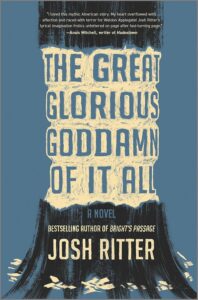
Ritter’s first novel, Bright’s Passage, actually began as a song. His second, The Great Glorious Goddamn of It All, stretches across the life of a 99-year-old former lumberjack.
Rockport MA Guide: Do you find that writing a novel gives you somewhere to take an idea that a three- or four-minute song simply can’t?
Ritter: You’re allowed to go places with a novel that you’re not necessarily allowed to go with a song. You can render the world more precisely.
You have the chance to build a world and color in a lot of that stuff.
But I’ve realized they’re actually a lot alike.
My imagination only takes the page of the song so far. Most of what I’m doing is kind of building a hallway.
I’m building a hallway for somebody to travel down in their own mind and go through any of those doors. I can’t go back there with them. That’s their own place.
With a novel, you’re rendering more of the world, but it still has to carry you through and have a through line.
I was initially impressed that I didn’t have to rhyme everything when I started writing novels.
Then I realized rhythm became even more important—the rhythm of the sentences.
So there was no get-out-of-jail-free card.
Rockport MA Guide: Are there more novels somewhere in that hallway?
Ritter: I’ve written several that aren’t any good in the meantime.
But one day.
We’ll be waiting.

Painting as a Way to Quiet the Noise
Ritter’s paintings aren’t simply another storytelling exercise. There’s also something much more personal behind them.
Rockport MA Guide: I’ve seen some of your paintings online, and they often feel like little scenes from stories that haven’t been written yet. When you paint, are you trying to tell a story without words, or are you deliberately giving yourself a creative outlet where you don’t have to tell a story at all?
Ritter: I tend to think of all art as a performance of some kind, so in that way I feel like there is a story being told.
But paintings are even more obscure than songs or novels because they rely completely on the mood of the painting itself and the sense of adventure that might be in it.
Painting for me has really been about quieting my mind down.
When I’m working on songs or whatever else I’m working on, I tend to feel like I overheat.
Painting gives me a place to let the back of my head work while also giving me a chance to plant a flag in my day.
It feels like I did something creative. Something useful.
And sometimes it gives you time while you’re waiting for the voice and the song to come back around.
It’s very good for me.

Boston, Open Mics and a Young Josh Ritter
Long before the albums and international tours, Ritter was a young musician living in Providence and making the trip to Boston to play open mics.
One of those nights changed his career: he met Glen Hansard, who would eventually invite him to Ireland to open for The Frames.
Rockport MA Guide: When you think back to that version of yourself, what did Boston give you as a young musician that you didn’t fully appreciate at the time?
Ritter: Boston gave me a chance.
I was mostly concerned with where I could play for as many people as possible. I also thought playing somewhere with lots of college folks around my own age would be good.
I didn’t want to move to New York because I felt like bands that started in New York never went anywhere else.
Boston gave me a chance to jump into a community that was really going at that moment.
There were so many open mics and bills I could split with people. There was an opportunity to play music almost every night if I wanted to.
It really shaped my whole career going forward.
I met a lot of people who changed my life at those open mics, but I also learned how to play a show, how to do a set and all the things you have to learn somewhere.
Boston was patient and gave me that chance.
And About That “Acting Career”…
Our initial research suggested Ritter had a few acting credits on imdb.com, including Aloha, The Hollars and Stronger.
There was only one problem.
Rockport MA Guide: You’ve also had what we might generously call a brief acting career, with appearances in Aloha, The Hollars and Stronger. Is acting something you still want to pursue?
Ritter: I never acted. I’ve just had songs in those movies.
Rockport MA Guide: Ah. That explains a few things.
Ritter: Lol. I don’t think anybody would want to see me on camera.
I’ve never been paid for being an actor yet, so maybe I should get in touch with them.
Nothing like finishing on a humble note…
Josh Ritter performs at the Shalin Liu Performance Center on October 28.
For more information and tickets, visit the Shalin Liu Performance Center website.