
Rockport’s July 4th Bonfire: A Search for Origins
Turns Out, It’s Not So Simple
It started with curiosity.
With the annual Rockport July 4th parade and bonfire approaching, the overly inquisitive part of my brain kicked in. How long has this tradition been going on? What does it actually take to build the bonfire? And what stories—factual or otherwise—exist around it?
Naturally, my first stop was where every lazy researcher begins… Google.
A search for “history of Rockport MA bonfire” proved less than satisfying. Conflicting dates, vague references, and more than a few “facts” that didn’t quite line up. So I graduated to ChatGPT (fact-checking the AI, of course—wink wink), only to find similar inconsistencies.
Confused, dissatisfied, and probably a bit over-ambitious, I made a decision: it was time to do some real research.
The Journey
If anyone were going to know the history of the Rockport bonfire, it would be the Rockport Fire Department—who manage the event—and/or the Sandy Bay Historical Society, which maintains local historical records.
I reached out to both. Each was incredibly accommodating to an amateur history buff who likely asked far more questions than expected.
What I found, however, wasn’t a clean set of confirmed facts tied together with a neat bow. Instead, I found something more interesting.
I leaned into the stories shared by individuals who were just as passionate about the tradition. I leaned into archived articles that, while sometimes conflicting on dates and details, painted a broader and more compelling picture.
Queue the easel, as here is that picture.
The History of the Bonfire and Parade
Bonfires have long been part of how New England communities mark Independence Day, and Rockport’s version sits within a much broader regional pattern. For generations, coastal towns have built large communal fires as a focal point for celebration—something that brought people together, made use of whatever materials were on hand, and created a spectacle big enough to draw a crowd.
Boston offers some of the clearest early examples of how widespread—and popular—these displays became. What began as smaller, tradition-driven gatherings gradually scaled into major public events by the early 20th century. A 1929 Boston Globe headline gives a sense of that growth:
“16 HUGE BONFIRES WELCOME FOURTH – Flare Forth at Midnight in Boston and Nearby Communities.”
The article went on to estimate that roughly 200,000 people gathered in Columbus Park alone to watch the fires, underscoring just how central they had become to the holiday.
Across New England, other towns followed a similar path, often pushing things a bit further each year. There was an unspoken competition to build higher, burn longer, and draw larger crowds. Structures grew increasingly ambitious, sometimes reaching dramatic heights and requiring weeks of preparation—less a simple pile of wood and more a carefully constructed centerpiece.
By the mid-20th century, however, this widespread “bonfire culture” began to fade. Several factors contributed to the shift, but one of the most significant was the increasing availability of fireworks, which became both more affordable and more accessible. As organized fireworks displays took center stage in many communities, large-scale bonfires gradually became less common—making places like Rockport, where the tradition endured, something of an outlier today.
Early Rockport Celebrations
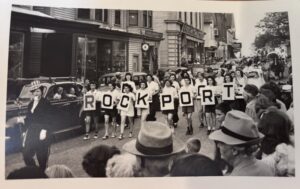
The earliest recorded reference to a July 4th celebration in Rockport dates back to 1854, noted in a town historical flyer as the first official parade.
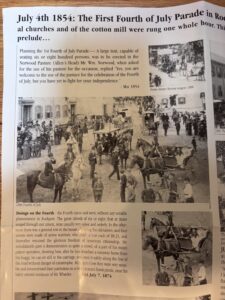
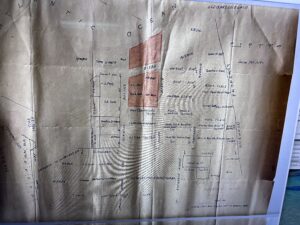
The day began with church bells ringing and a booming cannon. Festivities were held in a large tent accommodating 600–800 people in Norwood’s Pasture—identified on a 1909 map as being near present-day areas around the Rockport Golf Club and Whale Cove.
The celebration was lively, to say the least. One account notes:
“In the afternoon was a general row in the house adjoining the old tavern, and four arrests were made of active warriors, who paid a fine each of $8.25, and thereafter resumed the glorious freedom of American citizenship.”
Not every year carried the same energy. An article from the Cape Ann Advertiser (a predecessor to the Gloucester Daily Times) observed a much quieter Fourth:
“There never was a more quiet day even on a Sunday than the fourth in Rockport… There was not even energy, patriotism sufficient to ring the bells at noon.”
The same article highlighted the arrival of P.T. Barnum’s circus as the main attraction and source of excitement around this time, including what was claimed to be the only living hippopotamus in North America—reportedly weighing 25,000 pounds. (For context, the largest recorded hippo in captivity weighed closer to 10,000 pounds, suggesting a bit of promotional exaggeration.)
Early 20th Century Records
Historical documentation becomes sparse in the late 19th century and resumes more consistently in the early 20th century.
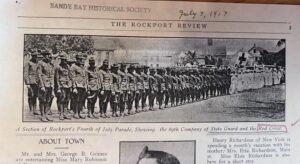
A July 7, 1917 issue of the Rockport Review included photographs of the parade but made no mention of a bonfire.
Similarly, a 1919 Gloucester Daily Times article declared:
“Rockport Celebration One of Greatest in Town’s History.”
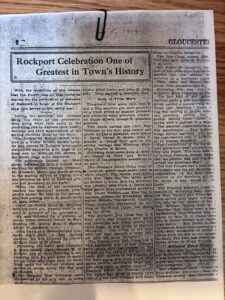
The piece described the parade in remarkable detail—highlighting floats, participants, decorations, and even the menu of a “splendid feast” held afterward. Notably, however, there was still no reference to a bonfire.
This absence suggests that while the parade was well established, the bonfire may not yet have been a formal or at least consistent feature.
Mid to Late 20th Century
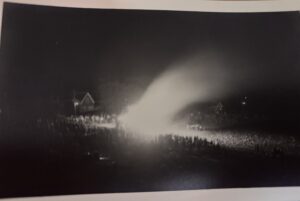
The more recent history of the bonfire has been largely been preserved through those who have promote, construct and manage it—members of the Rockport Fire Department.
In an undated Gloucester Times article, a former Rockport Firemen’s Association member Phil Tanson stated that the annual bonfire tradition began in the late 1940s. Current members of the Fire Department recall family involvement dating back to the 1970s, reinforcing the idea that the organized tradition likely does not predate the mid-20th century.
Constructing a Bonfire
The way the bonfire is built has shifted significantly over time, usually in response to practicality, availability of materials, and lessons learned from previous years.
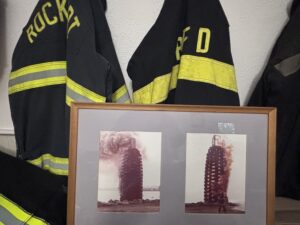
In the earliest widely referenced period (generally the late 1940s through the 1960s), the structure was built using empty barrels, stacked and arranged in a way that provided both height and airflow. By the 1970s, the design evolved into something more industrial in nature, with railroad ties becoming the primary building material. These heavy wooden beams (the kind used between train rails) were stacked into tall conical or teepee-like shapes, which were structurally impressive but had one notable drawback—they burned very slowly. In fact, remnants from these fires were known to linger for days afterward, sometimes smoldering well beyond the event itself.
By the early 2000s, the construction shifted again to wooden pallets, which remain the foundation of the modern bonfire. These are often donated by local businesses (including places like The Building Center, Ace Hardware, and nearby fishing piers), and they provide a far more efficient and predictable burn.
Today’s structure typically uses around 1,500 pallets and reaches somewhere in the 40–50 foot range (though, to be clear, no one is formally surveying it with measuring equipment during construction). The process itself is relatively fast: a crane lifts pallets into place while a small crew—usually five or six people—guides and interlocks each piece, gradually building the structure upward in a controlled way. In favorable conditions, the entire frame can be assembled in about a day.
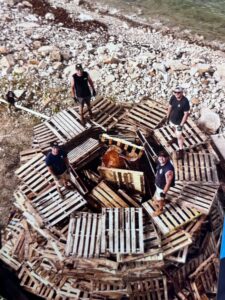
What emerges is a modern version of the bonfire that is more regulated and consistent than its predecessors, but still very much rooted in the same communal, hands-on tradition.
The Topper Tradition
At the top of the structure, there is always something—an element that signals not just completion, but identity.
While the exact origins are a bit murky (as is the case with much of the bonfire’s early history), there are longstanding references to an outhouse once serving as a topper, possibly dating back to the late 1940s. No one seems entirely certain why that became a tradition, but it has persisted in local memory as one of those details that may or may not be fully verifiable, yet still widely repeated.
In more recent years, the topper has taken on a more intentional role, often aligning with that year’s parade theme. In 2026, for example, the design is expected to reflect the United States Semiquincentennial (the 250th anniversary of the Declaration of Independence). In 2025, it humorously referenced a local woodpecker that had gained unexpected regional and national attention (https://www.wcvb.com/article/woodpecker-rockport-massachusetts-damage/64479657). In 2023, Motif No. 1 sat at the top of the structure, tying the event back to one of Rockport’s most recognizable symbols.
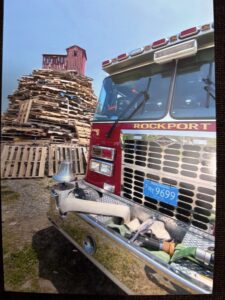
In many ways, the topper has become less about tradition in the strict historical sense and more about storytelling—an annual marker that reflects what Rockport is thinking about, talking about, or celebrating in that particular moment in time.
Lighting and Safety
The bonfire is typically lit around dusk (approximately 9:00 PM) and is scheduled rain or shine (a rain date exists but has reportedly never been used).
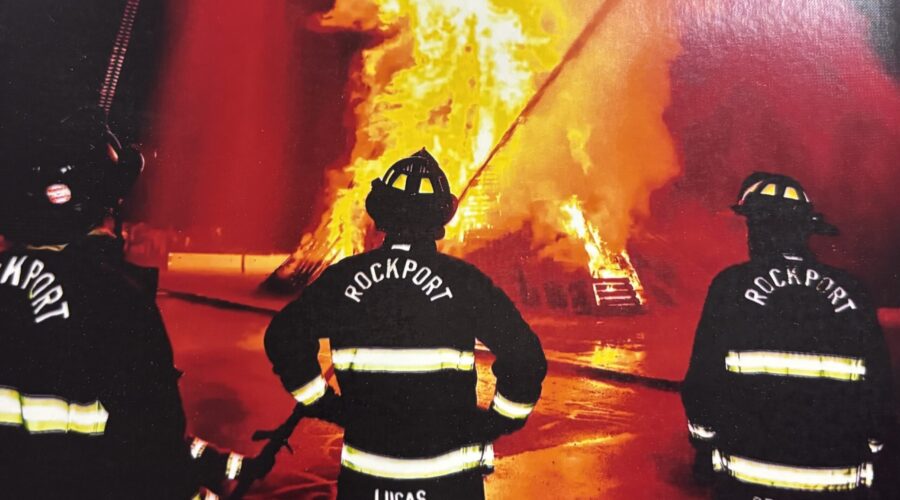
Ignition is relatively simple—newspaper and a small amount of kerosene are usually enough to get things going. Because the pallets are so dry, the fire spreads quickly and can reach temperatures of 1,200–1,500°F.
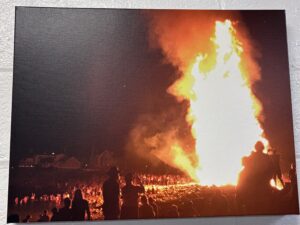
First-time attendees are often easy to spot—they’re the ones who instinctively step closer right after ignition, only to realize (almost immediately) that the heat has other plans.
The event itself is carefully managed, with the full Rockport Fire Department (roughly 25–30 members), along with the police department and department of public works (DPW), all playing a role. There’s also the somewhat curious but consistent presence of a visiting fire crew from Westbrook, CT—something that has become a tradition in its own right, even if its origins aren’t entirely clear.
Fire control typically involves multiple hose lines, a ladder truck, and rotating crews, since the intensity of the heat makes it impossible for anyone to stay in position for too long.
Cleanup
Like any well-run event, the bonfire doesn’t end when the flames die down.
While the fire itself usually burns out between midnight and 1:00 AM, cleanup efforts are already underway by the next morning. The process is relatively efficient—thanks in part to the fire itself, which consumes most of the materials, including nails.
What remains is cleared, a fresh layer of stone is spread over the site, and within a couple of weeks, there’s little visible indication that anything happened there at all.
2026: What to Expect This Year
Parade
- Route: Begins at the school complex on Jerden’s Lane, proceeds down South Street to Dock Square, continues up Main Street, and concludes near Back Beach at the American Legion bandstand
- Time: 6:00 PM start
Bonfire
- Location: Back Beach
- Time: Approximately 9:00 PM
Final Observations
The full origin story behind Rockport’s July 4th traditions is, at best, incomplete—dates blur, details conflict, and some elements seem to exist more in memory than in anything formally recorded.
But that process revealed something just as important.
History doesn’t really preserve itself; it relies on people to document it, question it, and pass it along. With local traditions especially, what survives isn’t always a clean, verified timeline, but rather a mix of firsthand accounts, archived references, and stories that have been told often enough to stick—even if the details shift slightly over time.
This effort didn’t resolve every inconsistency (far from it), and it didn’t uncover a single defining “first year” for the bonfire. What it did do was capture a moment—pulling together perspectives from those who have been part of it, alongside records that, while occasionally imperfect, still help shape the broader picture.
And maybe that’s the point.
Traditions like this don’t begin all at once. They take form gradually (year after year, story after story), until the exact origin matters a little less than the fact that they continue at all.